
blog detail
July 1, 2026
Telemonitoring
What happens when healthcare stops being defined by where the clinic is?
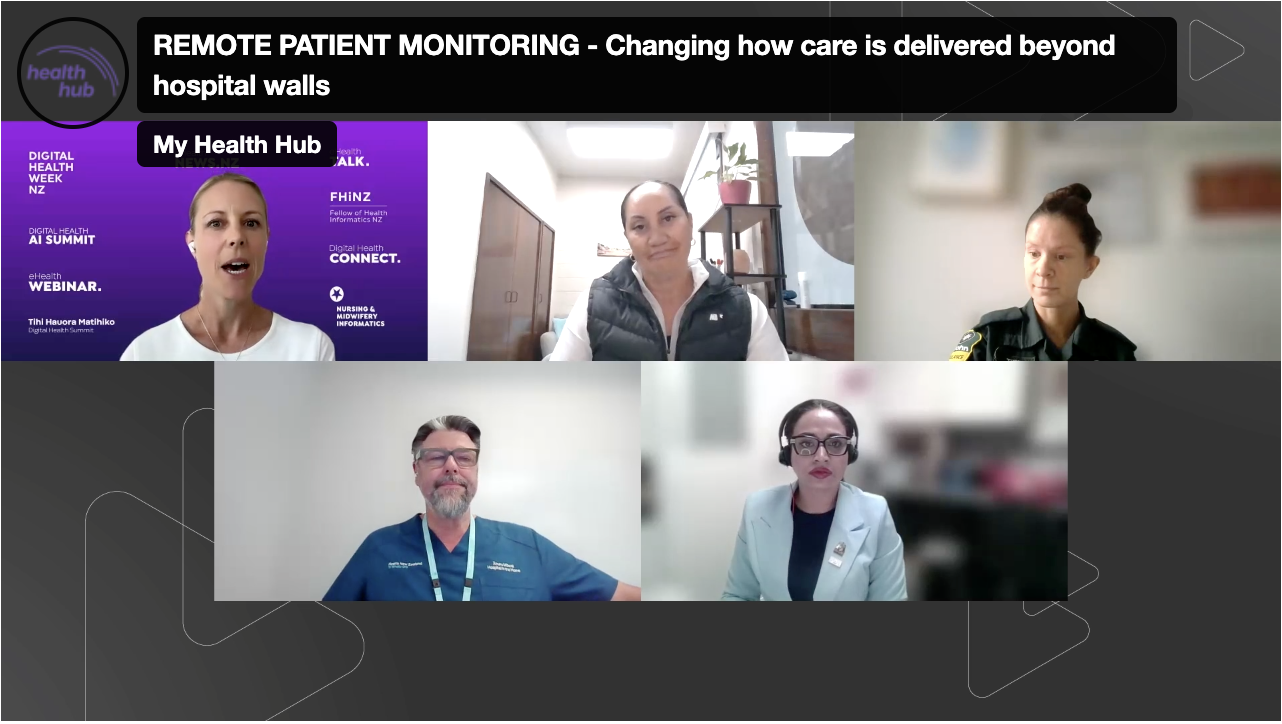
That was the question atthe heart of this Health Informatics New Zealand (HiNZ) webinar from earlierthis year, Remote PatientMonitoring - Changing how care is delivered beyond hospital walls.
The webinar brought together clinicians and health leaders to share what they are learning from putting remote patient monitoring (RPM) into practice. The examples were diverse; from Hospital in the Home in the Northern Region, to heart failure care in Hawke’s Bay, preventative cardiovascular care with Hato Hone St John, and health services delivered through a marae.
Together, they demonstrated something important: remote monitoring isn't a single model of care. It is a tool that can help clinical teams rethink where care happens, how often patients need to comeinto hospital, and how clinicians stay connected between appointments. Differentpatients and different clinicians often need different RPM tools. There isn’tone single platform that can deliver what is required for every possible usecase.
One of the examples featured was the heart failure programme in Hawke’s Bay, where the clinical team shared their experience using Spritely to support patients through guideline-directed medical therapy (GDMT) up-titration.
Traditionally, optimising heart failure medications can require repeated face-to-face appointments, with relatively long gaps between clinical reviews. The Hawke’s Bay team has instead used a remote monitoring model to monitor patients at home and make medication adjustments more quickly.
The results are impressive.Around 80% of patients reached optimal medication doses within eight weeks, compared with many months under standard care. The programme has also demonstrated substantially fewer hospital admissions and bed days during the up-titration process.
For Spritely, this is exactly why remote monitoring matters.
The technology isn't intended to replace clinicians. It gives them a better way to stay connected with patients between traditional points of care, allowing measurements and symptoms as well as other information to be collected at home and brought into the clinical workflow, adding speed and safety without adding extra burden to either the patient or the clinician.
The webinar also highlighted a very different application of Spritely through Manaaki Mamao,Hato Hone St John’s innovative preventative telehealth programme.
Manaaki Mamao - meaning to care from a distance - was developed with hauora Māori providers to support Māori and Pacific peoples with hypertension who are at increased risk of heart attack and stroke.
Rather than waiting for someone to become acutely unwell and require an ambulance or hospital treatment, the programme brings proactive cardiovascular care into the home.
Participants receive a simple Spritely device kit, including a connected blood pressure monitor, and record their blood pressure regularly. Hato Hone St John clinicians can review the results remotely, provide coaching and education, conduct video consultations and intervene when readings indicate that additional support is needed.
The results published in the New Zealand Medical Journal are particularly encouraging. Across the first two years of the programme, 143 people were successfully onboarded, with 69% completing six months. Participants' final recorded weekly systolic blood pressure was, on average, 7.78 mmHg lower than at the beginning of the programme. Among participants with strong engagement, the reduction was 9.9 mmHg.
Lowering blood pressure can materially reduce cardiovascular risk making Manaaki Mamao an example of technology being used not just to manage illness, but to prevent it from happening in the first place.
What makes Manaaki Mamao particularly powerful is that the technology is only one part of the model.
Hato Hone St John works with local hauora Māori providers and GPs, who identify and refer people who could benefit. The programme combines remote monitoring with clinical support, education, medication reminders and regular contact. The approach was developed with Māori and Pacific communities, with a focus on making care accessible and relevant to the people it is designed to support.
The examples featured in the HiNZ webinar show how remote patient monitoring can support people at very different points on the health journey.
It can help a heart failure patient reach optimal medication doses faster. It can help someone with hypertension reduce their cardiovascular risk before they experience a heart attack or stroke. And it can help health services deliver care to people who may otherwise face significant barriers to accessing it.
The common thread is bringing the right care closer to the patient.
When technology is combined with strong clinical models and thoughtful implementation, the resultisn't simply digital healthcare, it is healthcare that can be delivered in moreplaces, at more appropriate times, and in ways that better fit the lives of the people receiving it.
And that is ultimately what remote patientmonitoring is about: taking care beyond hospital walls and putting it where it can make the greatest difference, closer to home.

September 1, 2026


Christchurch, NZ

info@spritely.co.nz
© 2025 Spritely. All rights reserved
